
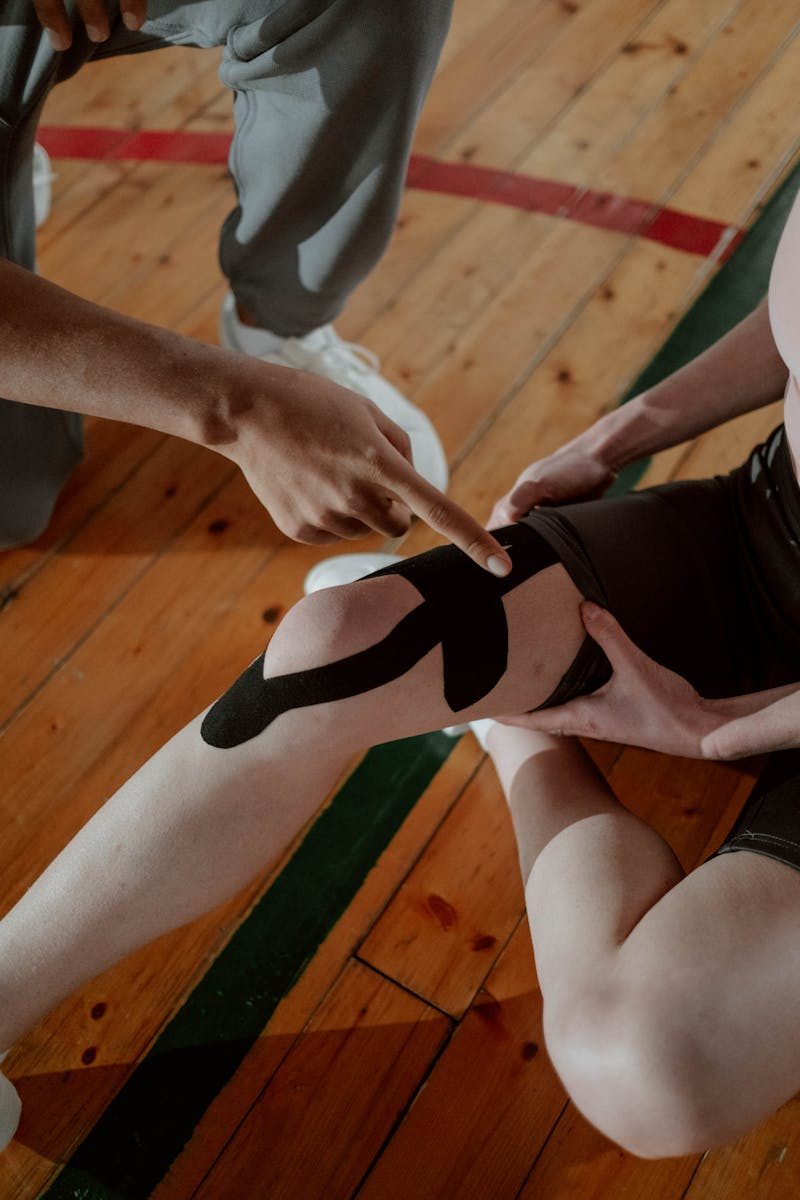
If your young athlete keeps pointing to a painful bump just below their kneecap after practice, games, or tournaments, you are probably not dealing with a “mysterious knee injury” — and it almost certainly is not because they are weak, lazy, or doing something wrong.
There is a very good chance they are dealing with Osgood-Schlatter disease, one of the most common causes of knee pain in growing athletes between the ages of 8 and 15.
And here is the important part most parents are never told:
This is not just a “rest until it calms down” problem.
This is a load-capacity problem.
The tissues around the knee are being asked to absorb more force than they are currently prepared to handle — especially during rapid growth spurts, high training volume, and explosive sports like volleyball, basketball, soccer, football, gymnastics, and track.
The good news?
With the right plan, most athletes do not need to completely stop sports, and we can help them come back stronger, more explosive, and more resilient than before their injury.
What Is Osgood-Schlatter Disease?
Despite the name, Osgood-Schlatter is not really a “disease” in the traditional sense.
It is a traction apophysitis — irritation of the growth plate where the patellar tendon attaches to the tibial tuberosity, the bony bump just below the kneecap.
Here is what is actually happening inside the knee:
Every time your child sprints, jumps, lands, cuts, or decelerates, the quadriceps generate massive force. That force travels through the patellar tendon and pulls directly on the growth plate at the top of the shin bone.
In adults, that attachment site is mature bone.
In growing athletes, it is still developing cartilage.
That means it is naturally more vulnerable to repetitive stress.
Now add in a growth spurt.
Bones lengthen rapidly, but muscles and tendons often cannot keep up fast enough. The quadriceps become relatively tight and less efficient at absorbing force. (<— the most important part) The patellar tendon experiences more tension. The growth plate gets overloaded thousands of times over the course of practices, games, tournaments, and training sessions.
Eventually the body starts sending warning signs:
- Pain directly below the kneecap
- Tenderness over the tibial tuberosity
- A visible or enlarged bump below the knee
- Pain with jumping, sprinting, squatting, stairs, or kneeling
- Pain that improves with rest but quickly returns with activity
- Stiffness after sitting for long periods
Osgood-Schlatter is especially common during peak growth velocity — typically ages 10–15 in boys and 8–13 in girls, though later growth spurts can absolutely push symptoms later as well.
And despite how common it is, the standard advice is still often:
“Just rest and wait.”
That is where things start going wrong.
Why “Rest Until It Stops Hurting” Usually Fails
Short-term load reduction absolutely has a place — especially during painful flare-ups and in at-home care
But complete rest is rarely the long-term solution and if you see a doctor or physical therapist for the condition, there is much more that could be done to speed up the process.
Tendons and connective tissue are living structures. They adapt to mechanical stress. When you completely remove load for long periods, you remove the stimulus that drives collagen remodeling, tendon organization, and force tolerance.
In simple terms:
The tendon does not become more prepared for sport by doing nothing.
This is why so many athletes follow the same frustrating cycle:
Pain → rest → temporary improvement → return to sport → pain again.
The real goal is not eliminating stress.
The goal is applying the right stress at the right time in the right amount.
That is how tissue adapts.
That is how athletes become durable again.
The Real Root Problem: Poor Force Absorption
One of the biggest mistakes in traditional rehab is focusing only on the painful spot.
The patellar tendon is usually not the true root cause.
The bigger issue is that the surrounding muscles are no longer absorbing force efficiently. The quads and calves should be doing most of the force absorption. If you have osgood-schlatter’s then we know for sure there is something not doing its job.
Think about what happens during sports:
- Landing from a jump
- Decelerating from a sprint
- Cutting laterally
- Absorbing impact forces over and over again
The forces that travel through the knee are enormous — often multiple times body weight in fractions of a second.
The job of the quadriceps, glutes, hamstrings, calves, and trunk is to absorb and distribute those forces before they overload a single structure. (like the knee)
But during growth spurts, athletes often temporarily lose coordination, stiffness control, strength, and eccentric force absorption capacity.
The muscles cannot keep up with the skeleton. Its actually a physics problem. As angles change with longer bone structure, muscles have a higher demand and over-contract to protect due to weakness.
So eventually the tendon and growth plate take the hit instead.
That is why simply waiting for pain to disappear often does not fix the issue.
The athlete returns with the same force absorption problem they had before.
What the Research Actually Shows About Tendon Healing
Modern tendon research has changed the way we think about conditions like Osgood-Schlatter.
The evidence strongly supports progressive mechanical loading — especially slow, controlled loading — as one of the primary drivers of tendon remodeling and resilience.
1. Slow Loading Matters More Than “Fancy” Exercises
Tendons respond extremely well to slow, controlled tension.
This type of loading stimulates tendon cells (tenocytes) to produce collagen and reorganize tissue structure more effectively than chaotic, explosive loading.
That is why rehab usually starts with:
- Isometrics
- Slow eccentrics
- Controlled strength work
- Progressive loading strategies
Not endless jumping drills.
Not “playing through it.”
Not complete shutdown.
2. Isometrics Can Calm Pain Without Completely Unloading the Tendon
Isometric exercises — contractions without movement — are one of the safest early loading tools for irritated patellar tendons and growth plates.
Examples include:
- Spanish squat holds
- Wall sits
- Split squat holds
- Isometric leg extension holds
These allow the quadriceps and tendon to receive a mechanical stimulus while minimizing excessive compression and irritation.
In many athletes, properly dosed isometrics can reduce pain while simultaneously preserving tendon capacity.
That matters because pain relief without maintaining load tolerance is usually temporary.
3. Eccentric Loading Helps Rebuild Tendon Capacity
As symptoms improve, slow eccentric loading becomes incredibly important.
Eccentrics occur when a muscle lengthens under tension — like the lowering phase of a squat or the deceleration phase of landing from a jump.
Research consistently shows eccentric loading can improve:
- Tendon stiffness
- Collagen organization
- Force absorption
- Load tolerance
- Neuromuscular control
For young athletes with Osgood-Schlatter, eccentrics help retrain the quadriceps, calves, low back and patellar tendon to manage force more effectively instead of dumping stress directly into the growth plate.
Where Flywheel Training Fits In
One of the most exciting developments in tendon and athletic rehab research is flywheel training.
Flywheel systems create resistance through rotational inertia rather than traditional gravity-based weights. The harder the athlete drives concentrically (up), the more eccentric (down) force they must absorb on the return phase.
That matters because tendons appear to respond extremely well to eccentric overload.
Research on flywheel training has shown improvements in:
- Tendon stiffness
- Rate of force development
- Eccentric strength
- Neuromuscular coordination
- Force absorption ability
For athletes recovering from tendon-related problems, properly progressed flywheel work may help restore the exact qualities often lost during growth spurts and injury cycles.
The key is progression.
Too much eccentric stress too early can absolutely flare symptoms in reactive tissues. But when introduced at the correct stage, flywheel training can become an incredibly powerful bridge between rehab and high-level athletic performance.
This is especially relevant for jumping athletes like volleyball and basketball players, where eccentric deceleration capacity is everything.
Direct Current Stimulation and Tendon Healing
Another emerging area of interest is direct current stimulation.
Research suggests direct current stimulation may help support tendon healing through several mechanisms:
- Improving local cellular activity
- Enhancing fibroblast function
- Supporting collagen synthesis
- Influencing tissue regeneration pathways
- Potentially improving circulation and tissue signaling
Some studies on electrical stimulation have shown improvements in tendon healing quality, collagen alignment, and recovery timelines when combined with proper mechanical loading.
But this part is critical:
No modality replaces loading. Rather, the modality allows us to load the tissue sooner and at higher intensities that are unable to be accomplished any other way.
Not just stim.
Not ice.
Not ultrasound.
Not passive treatment.
The body still requires progressive mechanical stress to remodel tendon tissue effectively and to rewire the brain to not compensate.
At Anderson Performance Rehab, we often view direct current stimulation as an amplifier — it gets us the fastest and safest results in the industry. When paired with the right loading strategy, it helps our patients and athletes tolerate rehab better, recover faster, and improve tissue quality while strength and force absorption are being rebuilt.
The Goal Is Not Just Pain Relief — It Is Capacity
One of the biggest mistakes we see is returning athletes to full activity the second pain improves.
Pain reduction does not automatically mean the tissue is prepared for high-force sport again.
The muscles still need force absorption capacity.
The nervous system still needs coordination and deceleration control.
That is why the best rehab plans progress in stages:
- Calm excessive irritation quickly
- Restore tendon loading tolerance
- Rebuild eccentric strength and force absorption
- Restore jumping, sprinting, and deceleration mechanics
- Progress back into full sport demands
Done correctly, many athletes actually return more resilient aka running faster and jumping higher than before with zero pain.
When Should You Get Your Athlete Evaluated?
You should absolutely seek professional evaluation if your child:
- Is limping
- Has pain at rest
- Has significant swelling
- Cannot tolerate normal activity
- Has symptoms lasting more than 2–3 weeks
- Is compensating or changing movement patterns
- Keeps having recurring flare-ups every season
Not every case of anterior knee pain is Osgood-Schlatter.
Patellar tendinopathy, stress injuries, Sinding-Larsen-Johansson syndrome, and other growth plate conditions can present similarly and require different management strategies.
Osgood-Schlatter Treatment in Mesa, Arizona
If your young athlete is struggling with knee pain, we help athletes throughout the Mesa and East Valley area return to sport with a modern, evidence-based approach built around tendon science, force absorption, and long-term athletic development.
At Anderson Performance Rehab, we do not just chase symptoms.
We focus on rebuilding the muscular and tendon capacity needed to handle the demands of sport — so your athlete does not just feel better temporarily, but becomes stronger, more explosive, and more durable long term.
That may include:
- Progressive tendon loading
- Isometric and eccentric training
- Flywheel-based force absorption work
- Direct current stimulation
- Jump mechanics
- Strength development
- Return-to-sport progression
- Sport-specific performance rehab
Your athlete does not need to sit on the sidelines hoping it magically resolves.
The right plan changes everything.
If your child is dealing with persistent knee pain, reach out today and let’s help them get back to doing what they love — stronger than before.
Comments are closed for this post.