
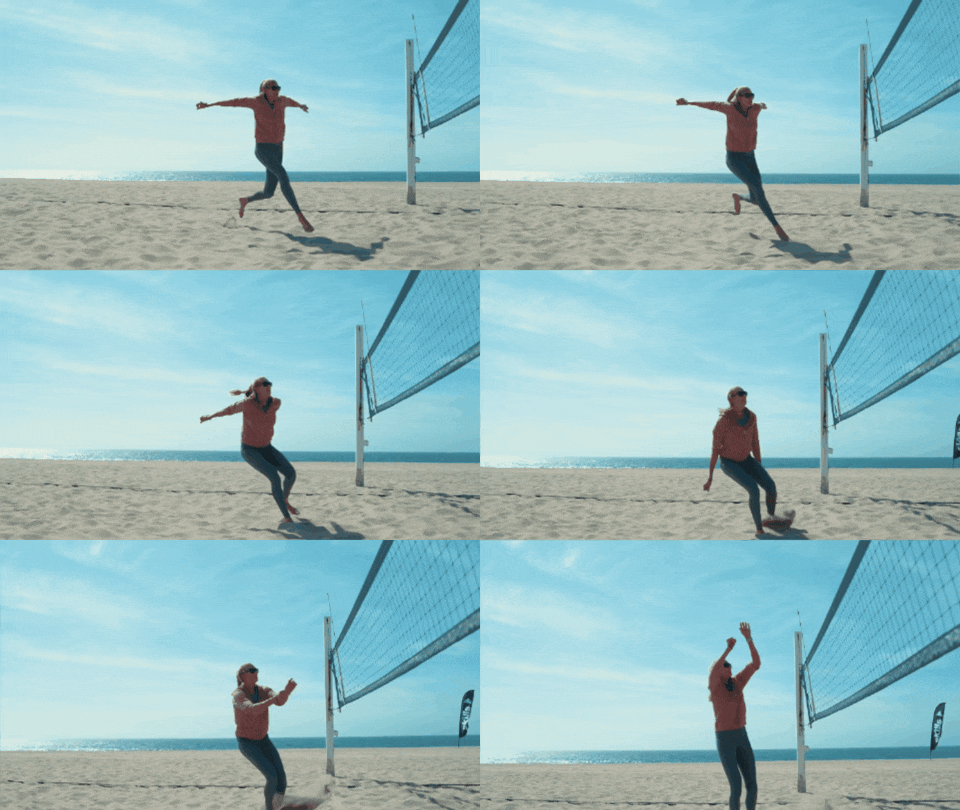
Knee pain in a beach volleyball player is easy to treat as a knee problem. The athlete points to the front of the knee, they hurt when they jump, land, or get low in defense, and the natural tendency is to stay local. We look at the patella, quadriceps, tendon, knee tracking, and amount of knee flexion they are using. Those things matter, but they rarely explain why that knee became overloaded in the first place.
In an athlete with a history of hamstring injury on the same side, the more useful question may be where they stopped producing force normally. If a hamstring injury changes the way the athlete uses the posterior chain, and that strategy persists after the hamstring stops hurting, then the knee can gradually become the place where the athlete starts doing more of the work.
Beach volleyball makes that particularly important because sand changes the mechanical problem. Sand is not simply a softer version of a hard court. It deforms under the athlete, absorbs energy, and forces the athlete to create more of their own stiffness and propulsion. Research comparing locomotion on sand with firmer surfaces has shown increased muscular demand, including greater hamstring activity.
That makes sense mechanically. On a firm surface, the athlete applies force into something relatively stable. On sand, part of that force is lost as the surface moves underneath them. The athlete still has to accelerate, decelerate, jump, and change direction, but they have to create more of the force themselves.
That places a large demand on the posterior chain.
A Healed Hamstring Is Not Necessarily a Normal Hamstring
One of the easiest mistakes to make in rehabilitation is confusing tissue healing with restoration of the original movement strategy.
Go back and read that line again!
The athlete strains a hamstring, the pain resolves, strength improves, and eventually they return to running and jumping. From a tissue standpoint, that can look like a successful recovery.
From a motor-control standpoint, there can still be a problem. The brain still remembers.
Pain changes motor output. Injury changes sensory input. The nervous system receives information from the injured tissue and adapts by reducing or altering recruitment. Early on, its a protective mechanism that you need. The body should probably reduce force through a freshly injured hamstring as to not make it worse.
The issue is that some of those protective changes can remain after the tissue has healed well enough to tolerate normal loading. The athlete may regain the ability to contract the hamstring while still underusing it during high-speed, long-muscle-length, or highly reactive movements.
This is why saying the hamstring is “shut off” can be useful clinically, even though it is not literally true. The muscle is still working. The better description is that recruitment may be reduced, delayed, or altered under certain conditions or positions. The most common position is in its fully lengthened or contracted state where it is at most risk.
That distinction matters. Even a manual muscle test can appear normal while the athlete still avoids the hamstring during sprinting, deceleration, landing, or cutting. A difficult Nordic curl can look strong while the athlete still fails to use the posterior chain when the movement becomes fast and unpredictable.
Strength and access to strength are not the same thing.
The Problem May Extend Beyond the Hamstring
The hamstrings do not work in isolation. They are part of a larger posterior-chain system that includes the gluteus maximus, pelvis, trunk, and lower leg. When one part of that system changes, other parts often change with it.
The gluteus maximus and hamstrings are both major hip extensors, but they do not simply duplicate each other. They share work differently depending on joint angle, speed, and task. Research following hamstring injury has shown altered lumbopelvic coordination and changes in gluteus maximus recruitment in some athletes.
This is where the clinical picture becomes more useful. An athlete can have a hamstring that tests reasonably well in isolation while the entire posterior chain is still organizing movement differently. They may have regained local strength without regaining normal force distribution.
That changes how we should look at knee pain.
The Body Still Has to Solve the Movement
The body is extremely good at finding another strategy when one area contributes less. If the hamstring contributes less and the glute is also contributing less effectively, the athlete does not suddenly lose the ability to jump or run. The nervous system finds another solution.
Often, that solution involves more knee-extensor work.
This is what we really mean by “quad dominance”. It does not mean the quadriceps are too strong. It means the athlete is solving a larger percentage of the movement through the knee extensors rather than sharing the work effectively between the hip and knee.
Biomechanical research supports this idea. When hip-extensor contribution decreases, knee-extensor work can increase. The movement still gets completed, but the distribution of work changes.
That is an important distinction. The athlete has not lost the movement. They have lost options within the movement.
A beach volleyball player still has to chase the ball, stop, jump, and recover. If the posterior chain contributes less, the quadriceps can make up the difference for a long time.
The problem begins when that temporary compensation becomes the athlete’s normal strategy.
Why Sand Can Magnify the Problem
Now put that athlete on sand.
They take a hard step toward a short ball. The foot sinks. Their center of mass keeps moving. The athlete has to control that motion, stop, and then accelerate again.
Ideally, the hip and knee share that job. The hamstrings and glute help absorb force while the quadriceps contribute at the knee.
But if posterior-chain contribution is reduced, the athlete can shift more of that workload toward the knee.
At first, that works perfectly well. The athlete still makes the play. There may be no pain at all.
Then they repeat that strategy hundreds of times. Add approach jumps, defensive pursuits, tournament weekends, fatigue, and repeated deceleration. The quadriceps continue solving the problem until the knee eventually becomes symptomatic.
This is why the painful tissue may not always identify where the movement problem started.
The knee may simply be where the athlete finally runs out of room to compensate.
The Quadriceps Are Not the Enemy
It is important not to turn this into a story about the quadriceps being bad. They are not.
The quadriceps are doing exactly what they are supposed to do. They create knee-extension torque, control knee flexion, contribute to jumping, and help support the body during landing and deceleration.
The issue is whether they are being asked to do more because another part of the system is doing less.
This can become relevant at the patellofemoral joint. Patellofemoral loading is influenced by both quadriceps force and knee angle. As knee flexion increases and the quadriceps work harder to control the body, the load through the joint can increase.
That does not make knee flexion dangerous or quadriceps loading harmful. It simply means that workload needs to be distributed.
If the athlete consistently uses less hip and more knee, the knee sees more of the problem.
Over one repetition, that may not matter.
Over thousands, it can.
What Should We Test?
We should start by testing each of the hamstring muscles and adductors. Next most common is going to be a sartorius or tfl that isn’t working properly.
After that, move into movement.
Watch a single-leg landing. Watch a lateral stop. Watch a crossover step. Watch the athlete decelerate out of an approach.
The question is not simply whether the knee moves inward. Look at where the athlete is choosing to absorb force.
Can they sit into the hip and load the posterior chain, or does everything shift forward into the knee?
Then make it faster and less predictable. A rehearsed exercise can look great because the athlete knows what is coming. Sport exposes the strategy the nervous system actually trusts.
That is usually where the compensation shows up.
Rehabilitation Has to Restore the Strategy
Hamstring rehabilitation should not end with making the hamstring stronger.
Strength matters. Long-muscle-length loading is important. Eccentric lengthening of a muscle under tentsions is critical. Glute capacity matters. But those are pieces of the process.
The final goal is to restore force distribution.
Early rehabilitation may include hamstring isometrics, long-lever bridges, sliders, Romanian deadlifts, hip-extension work, and progressive eccentric loading. Later, that needs to become single-leg force absorption, reactive catches, lateral stopping, sprint acceleration, deceleration, approach mechanics, and repeated jumping.
Then those movements need to go back onto sand.
I don’t use Nordic curls as a critical measurment as compensations from other muscles are huge in most athletes.
The real test is always return to play. Get back on the court and see how it goes.
The Clinical Takeaway
The model is straightforward.
A hamstring injury can alter neural drive (brain) and hamstring recruitment. That can change how the glute and posterior chain contribute to movement. The athlete still has to produce force, so more work may shift toward the knee extensors (front of the knee).
That compensation can be successful for a long time.
Eventually, however, the knee may become the region that starts to hurt.
This does not mean every beach volleyball player with knee pain has an old hamstring problem. It means a previous ipsilateral or same side hamstring injury should immediately change the examination.
The knee tells you where the athlete is hurting now.
The hamstring history may help explain how they got there.
If you have tried rehab or pt and didn’t see the results you needed we are here to look deeper into your knee pain, jumpers knee or other injuries. Some knee pain goes down as far as the toes, so a complete history and examination is critical in order to determine where the pain is coming from. Call or text the office with your injury and we will let you know if we can help!